
Beyond the Gates of Antares: Heroic Edition sets out to streamline play, reduce cognitive load, and create cinematic moments you’ll remember—whether you were the fortunate protagonist or the unlucky recipient of a decisive blow.
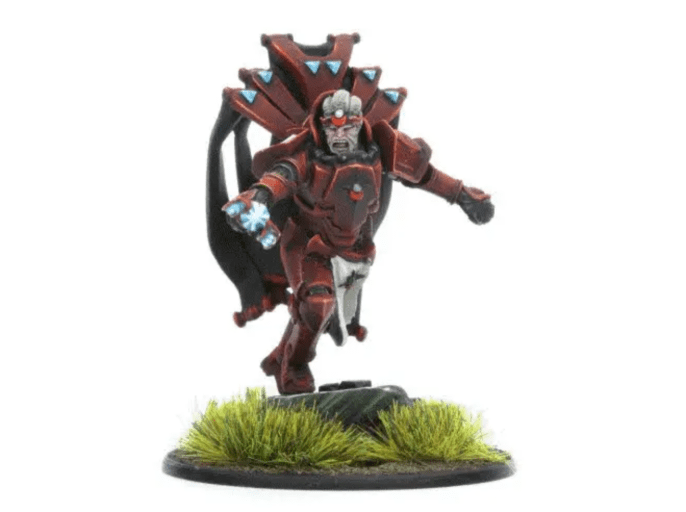
Today I want to start with a focus on the area that gives the new edition its name: heroes. In previous editions of Antares, we have had a number of characters to choose from when building our forces. The Freeborn mercenary Hansa Nairoba, the Ghar commander-turned-rebel-turned-commander again Fartok, and the Algoryn general Tar Es Janar are just a few of the notable names of the seventh age that might adorn the battlefield.
In my youth, playing the second edition of Warhammer 40k on my bedroom floor, I recall special characters being a fun but overpowered part of the game. There is certainly a balance to be had between game-breakingly awesome and underwhelmingly average. As things stand, my opponents and I rarely field character units because they often provide too little benefit for the points, particularly given how easily they might be removed from the table.
The goal with Heroic Edition characters is to give you, the player, a compelling unit around which to build your narrative without making them an overpowered must-have. Named characters should feel larger than life, but their downfall should be inevitable if faced with overwhelming odds and enough time.
A Heroic Retinue
To start with, I examined what made these characters feel vulnerable in second edition, referring to such characters with the term Hero (even though some are perhaps less than heroic). Fielded on their own, heroes like Hansa Nairoba feel vulnerable to one good round of shooting, so I started by looking at how retinues might work in Heroic Edition.
A retinue is a catch all term for any infantry unit that accompanies a named character. These exist in 2E in a limited fashion – character models often have the option to take 1 or more bodyguards. Even so, these were often fixed to specific models, and even with the bodyguards, character units are fragile and rarely justify the points invested (in my own experience – your mileage may vary).
With the changes to hit allocation, it becomes necessary to handle units containing models with different Res values than their retinue, since it is impossible to know whether the retinue will survive a bout of shooting and which hits should therefore be passed onto the hero. When assigning hits to a unit with an attached hero, the retinue or bodyguard always takes damage before the hero. This represents the cinematic way that heroes in movies always outlive their supporting cast – whether through skill or cowardice is up to you.
If the retinue are wiped out, any remaining hits are then re-rolled against the hero’s Res. This should prevent cynical 1-model bodyguards that absorb all incoming fire for one turn.
The exception to this is lucky hits, which may be assigned to the hero first.
Attaching Heroes to a Unit
Force commanders, heroes and other notable individuals often lend their experience to front line troops or are accompanied by a retinue of bodyguards. This is the only case in which different models in the same unit might have different res values. When a hero is attached to a unit, the following rules apply.
- a hero may only be attached to one unit, and unless otherwise stated, each unit may only have one attached hero;
- when attached to a unit, a hero does not have its own order die, and must maintain unit cohesion with the unit;
- if the rest of the unit is destroyed, the hero cannot be attached to another unit;
- the whole unit uses the hero’s Co and Init stats;
- if the hero and unit have different movement values, use the lower of the two;
- if the hero is attached to a unit with special rules that the hero lacks, those rules apply only to the non-hero models in the unit;
- a unit with an attached hero is not subject to break tests for losing half of its starting strength, although it can still be broken in close combat;
Wounds and Damage
In previous editions, the Wound special rule existed primarily to keep leaders alive a little longer. In practice, it introduced extra bookkeeping—requiring separate tracking from pins—and imposed a permanent penalty on the unit. Functional, but neither especially elegant nor particularly cinematic.
In the Heroic Edition, this system has been replaced with something more expressive.
All models now have a Wound  characteristic, and all weapons have a Damage Value (DV).
- Most infantry have 1 Wound
- Tougher infantry, such as Algoryn, Krasz and Boromites, have 2 Wounds
- Heroes and particularly fearsome infantry (Tsan-Ra) have 3 Wounds
Rather than tracking wounds individually, damage is resolved in a single step:
Add together the DV of all unsaved hits, then divide by the target’s Wounds, rounding down.
The result is the number of casualties inflicted.
There is one important limitation:
- A single hit can only ever cause one casualty.
A DV3 hit cannot remove three W1 models—but three DV1 hits can remove a single W3 model.
Non-lethal Damage
If an attack inflicts unsaved damage but does not cause any casualties, the target unit suffers one additional pin, provided the total unsaved damage is at least half the target’s Wounds value, rounding up.
If the attack causes one or more casualties, no additional pin is added for excess damage.
This represents the disruption caused by injured troops without introducing ongoing bookkeeping. Unlike previous editions, this is not a permanent penalty—the additional pin can be removed as normal.
What This Changes
t’s worth noting that the Wound rule itself was relatively rare in previous editions, typically limited to a small number of character models. As a result, this change does not significantly reduce the number of rules in the game.
Instead, it shifts where that complexity sits. Rather than tracking wounds across multiple turns with separate counters, all damage is resolved immediately and cleanly at the point of impact. In practice, this reduces ongoing bookkeeping and keeps the focus on the current state of the battlefield.
This is also more than a mechanical tweak—it reshapes how units and weapons interact.
- A rapid fire DV1 weapon is efficient against lightly-armoured, single-wound infantry
- Higher-DV weapons are more effective against tougher, multi-wound targets
This creates clear, intuitive roles:
- Volume of fire for clearing light troops
- High-impact shots for dealing with resilient enemies
- Flexible weapons like the plasma carbine become situationally more valuable than their stat line might suggest
- Larger squads are better at dealing damage to tougher targets due to the effect of damage pooling
Crucially, this emerges naturally from the system—no additional rules or exceptions required.
Example
A unit of five Algoryn fire their mag rifles (SV1, DV1) at a unit of Tsan Ra with 3 Wounds each, scoring 3 hits.
The Tsan Ra have Res 8, reduced to 7 by the mag rifles’ SV1. The Isorian player rolls three saves and only passes one, resulting in 2 unsaved hits (DV2 total).
- Against standard infantry, this would cause 2 casualties and 1 pin
- Against Tsan Ra, this is not enough to remove a model, but causes 2 pins
- If instead the Tsan Ra player failed 3 saves, the volley would cause 1 casualty and 1 pin
The unit will typically take:
- 1 pin for being hit
- +1 pin if unsaved damage was not enough to inflict a casualty
Damage Pooling in Large vs Small Units
My initial reaction to the above example was that I’d gotten it wrong, that Tsan-Ra were too tough. But then I realised that I’d inadvertently solved another problem I’ve had with list building for some time, which is that there is rarely a reason to increase the squad size of a unit, since the value of an extra order die is often too great to pass up. Second edition solves this to some extent by making squad upgrades more efficient, but the way damage pooling works in Heroic Edition takes this a step further.
Consider the previous example: the Tsan Ra are particularly hard to shift with a unit of 5 Algoryn troops with Mag Rifles or Repeaters. This highlights another emergent benefit of the system, which is that larger units are more effective at damage pooling than smaller ones.
Experience on the tabletop is always more valuable than theory crafting, but let’s crunch the numbers anyway so you get an idea of what I’m talking about. Let’s pitch two units of 5 Algoryn against the Tsan-Ra, versus one unit of 10 Algoryn.
First, let’s look at the chance to inflict a casualty with Mag Rifles, with their SV1, DV1. The difference is more pronounced than it first appears:
| Attacking unit | Shots | Chance of 1+ casualty |
|---|---|---|
| 5 Algoryn | 5 | 2.7% |
| Two units of 5 | 5 + 5 separately | 5.2% |
| One unit of 10 | 10 together | 18.0% |
So one 10-model unit is over three times as likely to cause a casualty as two 5-model units.
Mag Repeaters benefit similarly, being overall still more lethal.
| Attacking unit | Shots | Chance of 1+ casualty |
|---|---|---|
| 5 Algoryn | 10 | 7.0% |
| Two units of 5 | 10 + 10 separately | 13.5% |
| One unit of 10 | 20 together | 32.3% |
Again, the larger unit is much better at converting chip damage into an actual kill.
So large squads trade order initiative for lethality. The rock-paper-scissors approach to list building feels both intuitive and tactically satisfying, any necessary balance changes in future should be minor enough to come through points adjustments.
Faction Identity Through Wounds
This change allows factions to feel distinct in a way that goes beyond simple stat differences.
- Algoryn and Boromites rely on physical resilience, absorbing punishment that would destroy other troops. Hazard Squads embody this with res 8 combined with W2, making them much less susceptible to low DV weapons.
- Concord and Isorians rely on advanced equipment and flexibility in attack. Their high Res protects them from many incoming shots, but when their armour fails they are physically vulnerable.
- Krasz provide the Concord a more resilient infantry option at a higher points cost, typically being tougher than standard W2 units due to better armour.
- Tsan Ra are particularly tough at W3, but their high points cost and low numbers mean they are countered by weapon teams or massed fire.
- Freeborn lack the inherent toughness of the Algoryn and have less access to advanced armour and weaponry than the Concord, but compensate with some of the most flexible force-building options in the game.
- Ghar field some of the most heavily armoured infantry in the form of battle suits, but the pilots inside are comparatively fragile. Their Outcast infantry instead relies on weight of numbers to absorb enemy fire. Battle Suits still feature flexible attack in the form of Scourer Squads, while Assault Squads have high DV in assault, making them deadly against even Tsan-Ra up close. More importantly, their high res is somewhat offset by their fragility inside their armour.
- Virai and Vorl are still under consideration. The Vorl in particular will require extensive playtesting due to the unique way their armour functions. I have some ideas that I will share at a later date.
Weapons follow the same logic.
For example, the plasma carbine now has two clearly defined roles:
- Focused fire (SV2, DV2) – ideal for dealing with tough, multi-wound targets
- Rapid fire (SV0, DV1) – more effective against lighter infantry
Neither is strictly better—the correct choice depends on the situation. That’s exactly the kind of decision the game should be asking players to make.
Conclusion
These changes are all about character – whether that is the character of an entire faction, or the heroic character inspiring your units to feats of valour in battle. The addition of wounds leads to:
- Stronger character units
- Less bookkeeping
- More cinematic outcomes
- Clearer battlefield roles
This system removes the need to track lingering damage and instead resolves everything at the point of impact. Play becomes cleaner, reinforces faction identity and ensures that weapon choice and target selection are meaningful decisions.


You must be logged in to post a comment.